
You Can’t Pour From an Empty Well: Why Educator Wellbeing Matters
- Rachel Smith

- Jun 22
- 4 min read
The WELL Framework: Wellbeing First
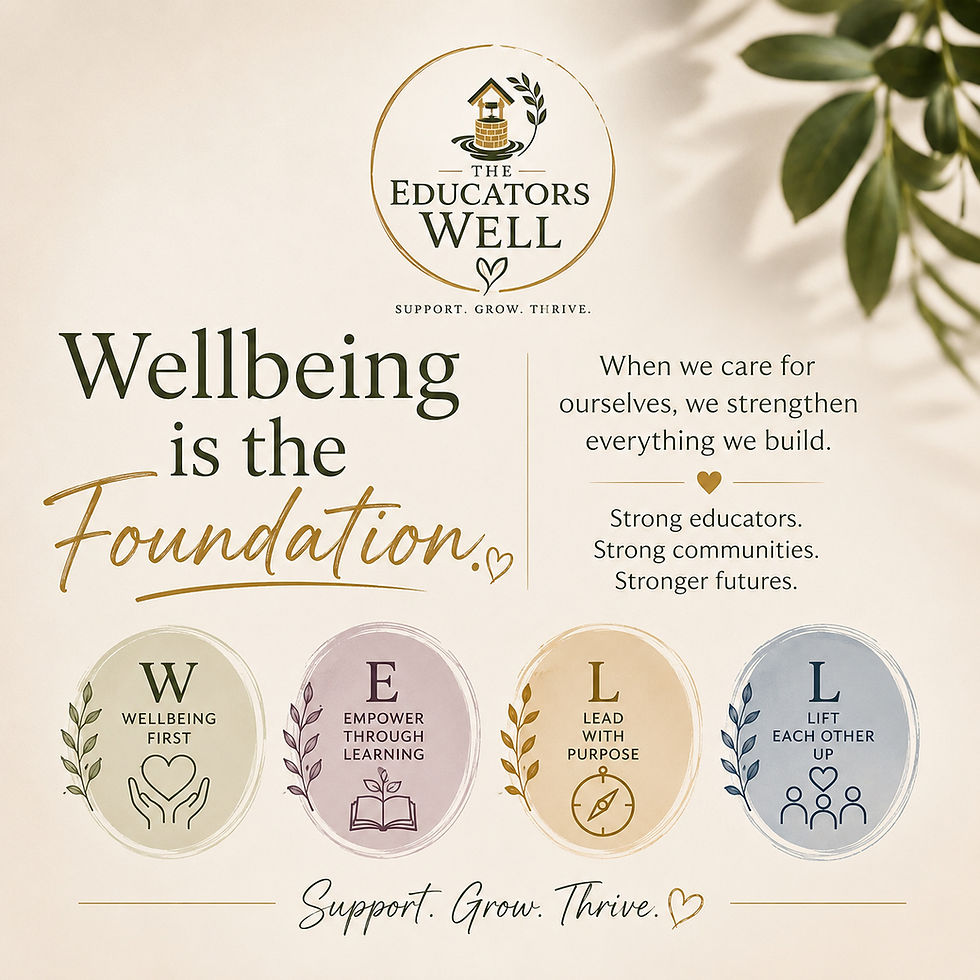
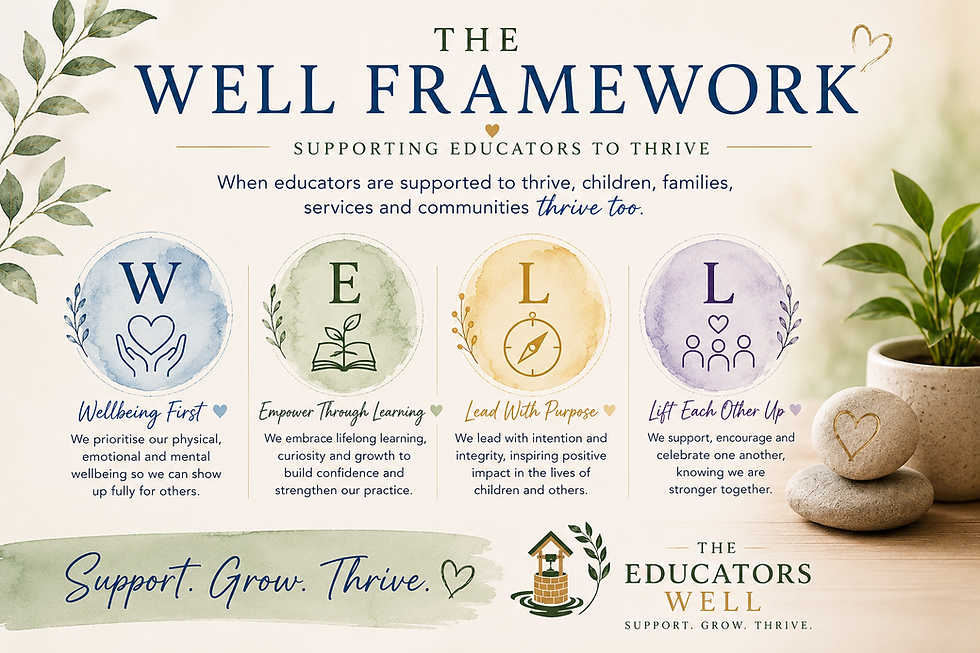
The WELL Framework is built on four interconnected pillars:
Wellbeing First
Empower Through Learning
Lead With Purpose
Lift Each Other Up
At The Educators Well, we believe these pillars are more than just professional concepts. They are stepping stones that support us not only as educators, but as people.
Each pillar builds upon the one before it.
When we prioritise wellbeing, we create a foundation for growth.
When we embrace learning, we develop confidence and capability.
When we lead with purpose, we create positive influence and meaningful change.
When we lift each other up, we strengthen our communities and ensure nobody has to walk the journey alone.
Over the coming weeks, we will explore each pillar in more detail, beginning with the foundation that everything else is built upon:
Wellbeing First.

You Can’t Pour From an Empty Well: Why Educator Wellbeing Matters
When we talk about quality early childhood education, we often talk about children.
We talk about learning outcomes, environments, relationships, documentation, programming, compliance, and continuous improvement.
But there is something else that sits quietly underneath all of those things.
The wellbeing of the educator.
Because behind every learning experience, every meaningful interaction, every carefully prepared environment, and every moment of care is a human being.
A human being who is carrying responsibilities, emotions, pressures, challenges, hopes, and dreams of their own.
Yet educator wellbeing is often treated as something extra. Something we focus on when we have time.
The reality is that educator wellbeing is not a bonus.
It is part of the foundation.
More Than Just Self-Care
When people hear the word wellbeing, they often think about bubble baths, massages, holidays, or taking a day off.
While those things can certainly be helpful, wellbeing runs much deeper than occasional acts of self-care.
True wellbeing includes:
• Physical health
• Emotional wellbeing
• Mental health
• Social connection
• Purpose and meaning
• Feeling valued and supported
• Having healthy boundaries
• Being able to cope with life’s challenges
Wellbeing is not about feeling happy all the time.
It is about having the resources, support, and resilience to navigate the ups and downs that naturally come with life and work.
The Cost of Running on Empty
Many educators are incredibly skilled at caring for everyone else.
They support children through big emotions.
They build relationships with families.
They encourage colleagues.
They solve problems, manage risks, meet compliance requirements, and juggle competing priorities every day.
But somewhere along the way, many forget to check in with themselves, or they only look at the surface.
The signs can be subtle at first.
Feeling constantly tired.
Losing motivation.
Feeling overwhelmed by small tasks.
Becoming emotionally exhausted.
Finding it harder to enjoy the work you once loved.
For some, it can lead to burnout, compassion fatigue, anxiety, stress-related illness, or leaving the profession altogether.
The challenge is that these things rarely happen overnight.
They often develop slowly, over months or even years, until one day we realise we have been running on empty for far too long.
Why Educator Wellbeing Matters for Children
Children learn through relationships.
They learn through connection, responsiveness, trust, and emotional safety.
While no educator needs to be perfect, our wellbeing does influence our ability to be present, patient, responsive, and engaged.
When educators are supported, valued, and well, they are better able to create environments where children can thrive.
This is not about placing more responsibility on educators.
It is about recognising an important truth:
Supporting children and supporting educators are not separate goals.
They go hand in hand.
The Foundation Beneath Everything Else
Imagine building a house.
You can invest in beautiful furniture, fresh paint, expensive appliances, and stunning landscaping.
But if the foundation is unstable, eventually cracks will begin to appear.
The same can be said for our professional lives.
We can focus on qualifications, professional development, compliance, leadership, and career progression.
But if our wellbeing is neglected, sustaining those things becomes increasingly difficult.
Wellbeing is not the reward we earn after everything else is done.
It is the foundation that allows everything else to stand.
In fact, this is why wellbeing sits first within the WELL Framework.
Without wellbeing, learning becomes harder.
Without wellbeing, leadership becomes exhausting.
Without wellbeing, it becomes difficult to support and uplift others.
Everything else grows from the foundation we build for ourselves.
A Question Worth Asking
As educators, we regularly reflect on children’s wellbeing.
Perhaps it is time we asked ourselves the same question.
How am I really doing?
Not as an educator.
Not as a colleague.
Not as a leader.
Not as a parent, partner, or friend.
As a person.
Because when we begin to value our own wellbeing as much as we value the wellbeing of those we care for, we create the conditions for sustainable careers, healthier workplaces, and stronger communities.
And that matters.
Because you cannot pour from an empty well.
Reflection Question
What is one small thing you could do this week to support your own wellbeing?
I’d love to hear your thoughts in the comments below.
💜 Rachel Smith
The Educators Well
Wellbeing First • Empower Through Learning • Lead With Purpose • Lift Each Other Up

Comments