
How Do We Build a Profession Where Educators Can Thrive for Decades?
- Rachel Smith
- Jun 10
- 6 min read
By Rachel Smith

The Early Childhood Education and Care sector spends a lot of time talking about recruitment.
We talk about attracting new educators.
We talk about workforce shortages.
We talk about vacancies.
We talk about retention.
And while these conversations are important, I wonder if we are asking the wrong question.
Perhaps the question is not:
“How do we recruit more educators?”
Perhaps the question is:
“How do we create a profession worth staying in?”
What would it look like if an educator entered our profession at twenty years old and still felt passionate, valued, healthy, connected, purposeful, and excited to contribute at sixty?
What would need to exist for that to become possible?
Would wages matter?
Absolutely.
Would professional recognition matter?
Without question.
Would leadership matter?
Yes.
Would wellbeing matter?
Of course.
Would learning, growth, connection, mentoring, and community matter?
I believe they would.
Because thriving is never the result of a single factor.
Thriving is the result of an ecosystem.
Yet too often, we approach these conversations in isolation.
One article discusses workforce reform.
Another discusses wellbeing.
Another discusses leadership.
Another discusses professional learning.
Another discusses burnout.
Another discusses retention.
But educators do not experience these things separately.
They experience them all at once.
The reality is that sustainable careers are built when all of these pieces work together.
Recently, workforce sustainability has emerged as one of the defining conversations within our sector.
And rightly so.
Because sustainability is about more than simply filling vacancies.
It is about creating conditions where educators can remain, grow, contribute, and flourish over the long term.
When experienced educators leave, we lose far more than a position on a roster.
We lose wisdom.
We lose mentoring.
We lose leadership.
We lose relationships.
We lose confidence.
We lose decades of knowledge and experience that cannot be replaced overnight.
Workforce sustainability is not simply about attracting new educators.
It is about ensuring the educators already here can see a future for themselves within the profession.
Perhaps the ultimate measure of workforce sustainability is not how many educators enter the profession each year.
Perhaps it is how many educators can imagine themselves still being part of the profession in ten, twenty, or thirty years’ time.
Can they see opportunities for growth?
Can they see pathways into leadership?
Can they see opportunities to mentor others?
Can they see pathways into training, advocacy, consulting, or specialisation?
Can they see a profession that values their experience?
Can they see a place where they belong?
Because if the answer is no, workforce sustainability is already under threat long before an educator submits their resignation.
For many years, our sector has focused heavily on attracting new educators into the profession.
Subsidised qualifications, fee-free training opportunities, and accelerated pathways have all played an important role in responding to workforce shortages.
However, I wonder whether we have spent enough time asking another question.
Are we preparing educators not only to enter the profession, but to remain in it?
In some cases, qualifications have been completed at a rapid pace, with graduates entering highly complex environments that demand emotional resilience, professional judgement, relationship-building skills, critical reflection, leadership capabilities, communication skills, and the ability to navigate increasing compliance expectations.
Yet many educators begin their careers without ever having meaningful conversations about professional sustainability.
How do we establish healthy boundaries?
How do we navigate workplace conflict?
How do we continue learning and growing?
How do we maintain our sense of purpose when challenges arise?
How do we build supportive professional networks?
How do we develop confidence in our practice?
How do we build a career that remains fulfilling over twenty or thirty years?
These are not optional skills.
They are essential skills.
Because workforce sustainability is not simply about helping educators gain a qualification.
It is about helping educators develop the knowledge, confidence, support networks, and professional foundations required to build a long and meaningful career.
If we truly want to strengthen the future of ECEC, we must move beyond asking how quickly we can bring people into the profession and begin asking how we can support them to thrive once they arrive.
Perhaps there is another piece of the workforce sustainability conversation that deserves more attention.
Listening.
Not through surveys.
Not through statistics.
Not through reports written about educators.
But by genuinely spending time with educators.
Sitting in services.
Talking with teams.
Visiting Family Day Care educators who often work in isolation.
Speaking with new educators entering the profession.
Listening to experienced educators who have spent decades supporting children and families.
Learning from leaders who are trying to balance quality, compliance, staffing, and sustainability every day.
Because if we truly want to understand why educators stay, why they leave, what they need, and what helps them thrive, we need to spend time with the people living that reality.
Not arriving with assumptions.
Not arriving with judgement.
Not arriving simply to identify what is wrong.
But arriving with curiosity.
With respect.
With a willingness to understand.
Sometimes the most valuable thing we can do is sit down, share a coffee, and have a genuine conversation.
Ask educators what is working.
Ask what is challenging.
Ask what support would make a difference.
Ask what keeps them passionate.
Ask what makes them consider leaving.
Because while workforce reports and sector data provide important information, there is something powerful about hearing directly from the people doing the work.
The educator supporting children through separation anxiety.
The Family Day Care educator working independently from home.
The educational leader mentoring their team.
The service leader trying to support both children and educators while navigating increasing expectations.
These voices matter.
And if workforce sustainability is truly the defining challenge of our profession, then the people closest to the work must also be part of the solution.
Some of the most valuable insights in our sector may not come from boardrooms, conferences, or policy documents.
They may come from conversations around staffroom tables, playgrounds, Family Day Care homes, and coffee cups shared between educators who simply want to do their best for children and families.
Perhaps before we ask how to fix the profession, we need to spend more time listening to the people living it.
These questions became deeply personal to me following my workplace injury and my ongoing journey living with Post-Concussion Syndrome.
Like many educators, I found myself navigating uncertainty.
I had to learn how to rebuild.
How to adapt.
How to continue moving forward while recognising that the old way of doing things was no longer sustainable.
Through that experience, I learned something important.
Wellbeing is not a luxury.
It is not a reward we earn once everything else is finished.
It is not something we focus on when we finally have time.
It is part of the foundation.
And foundations matter.
Because when foundations weaken, cracks begin to appear.
Not only in buildings.
But in people.
And eventually, in professions.
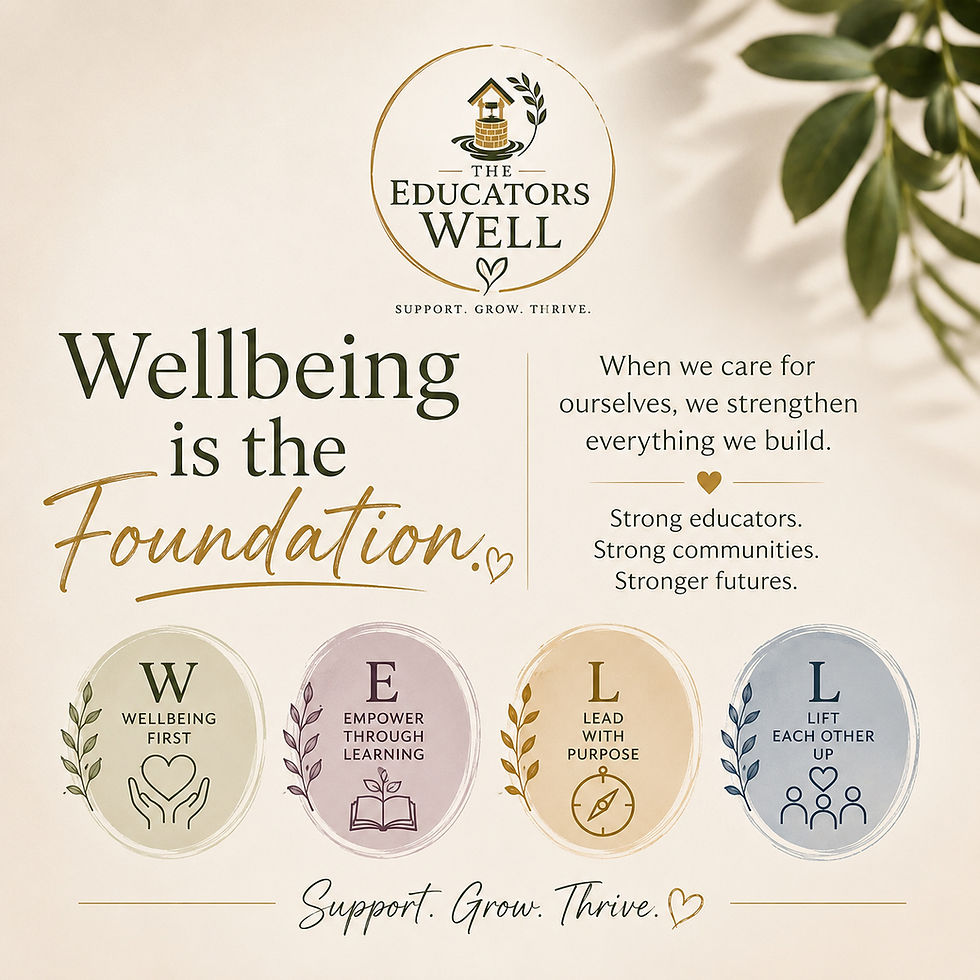
This belief became the starting point for the WELL Framework.
W – Wellbeing First
E – Empower Through Learning
L – Lead With Purpose
L – Lift Each Other Up
The WELL Framework was created by an educator, for educators.
It was developed from almost two decades of experience across Family Day Care, In-Home Care, and Early Childhood Education.
It was shaped through conversations with educators, leaders, students, families, and services.
And it was strengthened through lived experience.
Not because I have all the answers.
But because I believe our profession deserves a deeper conversation.
One that moves beyond surviving.
One that explores what it truly means to thrive.
This is why I am excited to soon launch the WELL Framework 12-Week Professional Development Program.
A program designed, written, and developed by an educator who understands both the beauty and the challenges of our profession.
A program that explores wellbeing, learning, leadership, connection, resilience, growth, purpose, reflection, and professional sustainability.
Not as separate topics.
But as interconnected parts of a thriving career.
Because perhaps the future of ECEC is not simply about recruiting more educators.
Perhaps it is about creating environments where educators want to stay.
Where they feel valued.
Where they continue learning.
Where they develop confidence.
Where they build meaningful relationships.
Where they discover purpose.
Where they support one another.
Where they can see a future for themselves within the profession.
I believe our profession is worth fighting for.
I believe there are extraordinary educators doing extraordinary work every single day.
I believe there are leaders striving to create better workplaces.
I believe there are services committed to supporting both children and educators.
I believe there are policymakers who genuinely care about the future of our sector.
Most importantly, I believe we have an opportunity to create something better.
A profession where educators are not simply recruited.
A profession where educators are supported.
A profession where educators are valued.
A profession where educators continue learning, leading, connecting, and growing throughout their careers.
A profession where experience is retained rather than lost.
A profession where people can build meaningful and sustainable careers.
A profession where educators can thrive for decades.
Because educators deserve more than survival.
They deserve the opportunity to flourish.
And perhaps that is the conversation that has the power to change everything.


Comments