
Educator Wellbeing Is Not a Band-Aid. It Is Part of the Foundation.
- Rachel Smith

- Jun 8
- 4 min read
By Rachel Smith
A recent article published by The Sector, Educator Wellbeing Debate Sparks Calls for Deeper Workforce Reform in ECEC, has generated important discussion across the Early Childhood Education and Care sector.
The article argues that we have become too focused on educator wellbeing initiatives while failing to address the deeper systemic issues driving workforce shortages, burnout, and educator attrition.
In many ways, I agree.
The article states:
“A breathing exercise cannot fix a fractured ratio. A meditation app cannot pay the rent on a poverty-level wage. And a wellness webinar cannot create the paid administrative hours required to survive a crushing compliance workload.”
It is difficult to argue with that statement.
A breathing exercise cannot fix a fractured ratio.
A mindfulness app cannot increase wages.
A wellbeing webinar cannot create additional staffing.
The workforce challenges facing our sector are real.
Educators are carrying increasing responsibilities.
Documentation expectations continue to grow.
The complexity of children’s needs continues to increase.
Many services continue to face workforce shortages, leaving educators stretched between competing demands.
These are not individual problems.
They are systemic ones.
They deserve serious attention and meaningful reform.
However, I believe there is an important piece missing from the conversation.
The discussion often positions educator wellbeing and systemic reform as though they are competing priorities.
As though we must choose one or the other.
I don’t believe that is true.
In fact, I believe the future sustainability of our profession depends on recognising that they are deeply interconnected.
The article also states:
“We have weaponised wellness to avoid doing the hard work of structural reform.”
There is truth in this observation.
If wellbeing initiatives are used as a substitute for workforce reform, then we have missed the point entirely.
If organisations can point to a wellbeing program while ignoring workload, staffing, professional recognition, or sustainable working conditions, then educators have every right to question whether meaningful change is actually occurring.
But I would argue that wellbeing itself is not the problem.
The problem is how we define it.
Too often, wellbeing is reduced to self-care checklists, mindfulness apps, yoga sessions, gratitude journals, or wellness programs.
While these things may have value for some people, they are not the whole picture.
Real wellbeing is much deeper.
It is not about helping educators tolerate broken systems.
It is about creating the conditions that allow educators to sustain themselves, grow, lead, learn, connect, and flourish within their professional lives.
Perhaps the best way to explain this is through a building analogy.
The sector often talks about wages, funding, ratios, compliance, leadership, policy, professional recognition, and workforce planning as though they are individual building blocks.
And they are.
Every one of those things matters.
But what happens when we build on an unstable foundation?
No matter how strong the walls are, cracks eventually appear.
No matter how carefully the structure is designed, pressure eventually takes its toll.
Eventually, things begin to fall apart.
A building requires both strong foundations and strong building materials.
The same is true for professions.
Systemic reform provides many of the building blocks.
Wellbeing is part of the foundation and part of the cement that holds those blocks together.
Without both, sustainability becomes difficult to achieve.
This understanding has shaped much of my own work.
Following a workplace injury and my ongoing experience living with Post-Concussion Syndrome, I learned something that fundamentally changed how I think about wellbeing.
No amount of positive thinking could heal an injured brain.
No wellness program could remove the challenges I was facing.
But neither could I simply ignore my wellbeing while waiting for circumstances to improve.
Recovery required multiple layers of support.
Medical care mattered.
Professional support mattered.
Workplace accommodations mattered.
Understanding mattered.
But so did learning.
So did connection.
So did purpose.
So did faith.
So did community.
So did developing sustainable strategies that allowed me to continue moving forward.
Over time, I realised that wellbeing was not something sitting outside the recovery process.
It was part of the infrastructure supporting it.
Perhaps the same is true for our profession.
This belief became one of the foundations of the WELL Framework.
Not because I believe wellbeing replaces systemic reform.
Not because I believe educators simply need to become more resilient.
And certainly not because I believe self-care can solve workforce shortages.
The WELL Framework was developed because I believe sustainable professions require sustainable people.
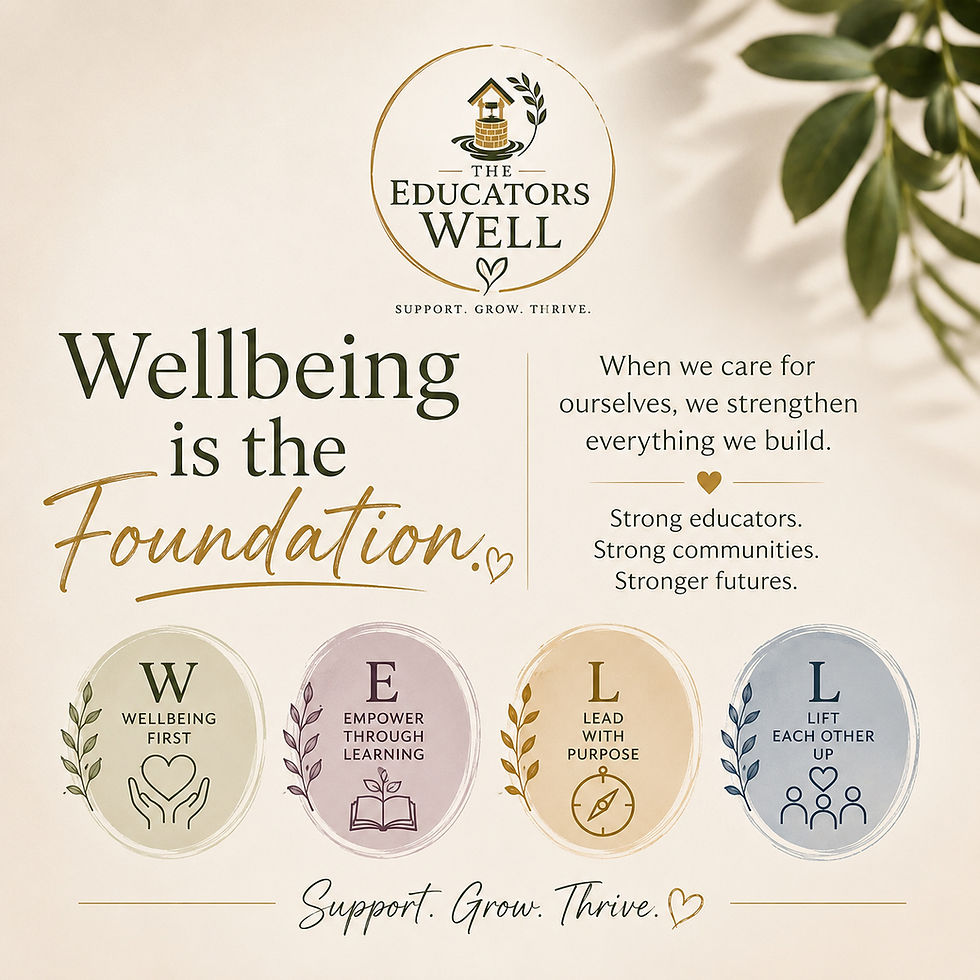
The framework is built around four interconnected pillars:
W – Wellbeing First
E – Empower Through Learning
L – Lead With Purpose
L – Lift Each Other Up
Together, these pillars acknowledge something important.
Burnout is rarely caused by a single factor.
It often emerges when multiple protective factors begin to disappear.
When people stop feeling valued.
When they stop feeling connected.
When they stop feeling supported.
When they lose sight of their purpose.
When they stop learning and growing.
When they begin carrying everything alone.
The answer is not simply teaching educators to cope better.
Nor is it waiting for governments, providers, and policymakers to solve every workforce challenge before supporting the people currently working within the system.
We need both.
We need advocacy.
We need workforce reform.
We need professional recognition.
We need sustainable workloads.
We need stronger career pathways.
We need meaningful conversations about wages and conditions.
And we need educators who feel supported, empowered, connected, and capable of building long and fulfilling careers.
The article concludes by calling for deeper workforce reform.
On that point, I believe many of us agree.
The question is not whether we should focus on educator wellbeing or workforce reform.
The question is whether we recognise how deeply connected they really are.
Because policies do not build relationships.
Frameworks do not inspire children.
Compliance systems do not create belonging.
People do.
And if we want a strong profession, we must invest in both the structures that support educators and the wellbeing of the people who bring those structures to life.
The future of Early Childhood Education and Care will not be secured by wellbeing initiatives alone.
Nor will it be secured by policy reform alone.
It will be built when we recognise that healthy systems and healthy people are not competing priorities.
They are partners.
Because educators deserve more than survival.
They deserve the opportunity to flourish.



Comments